


 Listen Live
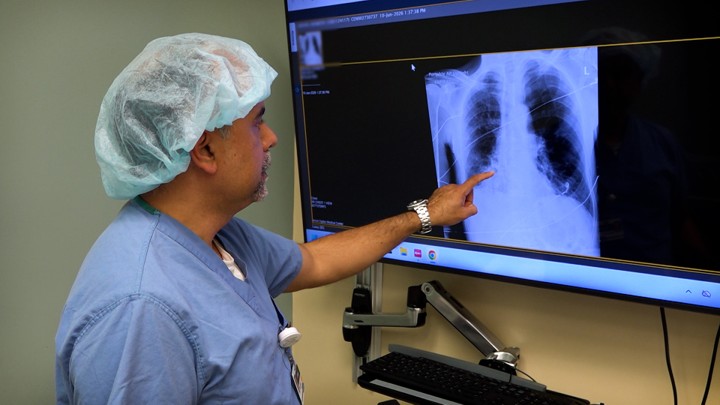

(607NewsNow) — If you’re between the ages of 50 and 80, have a 20-pack-year smoking history, and currently smoke or have smoked within the last 15 years, you may be at high risk for developing lung cancer. Health experts recommend annual screening for signs of cancer. Lung nodules, small abnormal growths, can only be detected through x-rays or CT scans, appearing as spots or shadows on the chest. Finding nodules early is crucial.
“Cancer grows aggressively, and as time passes the stage of the cancer becomes more advanced,” says Dr. Asad Nasir, Pulmonologist at Arnot Health, a Member of Centralus Health.
Discovering a spot on a scan often leads to a referral to the Rapid Lung Nodule Clinic at Arnot Ogden Medical Center. Patients often require multiple scans before they can move forward with a diagnostic procedure.
“We developed a rapid nodule clinic back in the fall. When we’re seeing these nodule patients, a lot of them can be biopsied by a standard bronchoscopy. Some of them can be biopsied by a CT-guided biopsy by the radiology department, but there are some nodules that can’t be reached by those means,” says Dr. Michelle Malnoske, Pulmonologist at Arnot Health, a Member of Centralus Health.
Standard bronchoscopies can only detect masses in large, central airways, limiting access to nodules in smaller areas of the lung.

“The scope is about the size of my pinky, but it only goes so far in the airways. If a nodule or lesion is farther than my scope can reach, we can’t get to it in the reliable sense.”
Through new navigation bronchoscopies, doctors can place guide tools through the airways to reach and biopsy hard-to-access lung nodules. The navigation system increases accuracy and efficiency while reducing the risk of procedure-related complications.
“This new technology can really help us diagnose those nodules that are in what I call ‘no man’s land.’ I call this the ‘GPS of the lung.’ We put sensors on the chest, format it with a CT scan and computer system, and it allows us to get a map to where this nodule is.”
Dr. Nasir says the new technology eliminates inaccuracies, allowing pulmonologists to find the exact location of the potentially cancerous mass.
“This will lead to better outcomes. If, unfortunately, it is a case of cancer, the sooner you diagnose, the sooner you start treating the patient and the better the outcomes.”
Arnot Health’s pulmonology department is located at 600 Roe Avenue, Elmira. Cayuga Health’s pulmonology departments are located at 201 Dates Drive, Suite 301, Ithaca; 220 Steuben Street, Montour Falls, and 260 Tompkins Street, Cortland