


 Listen Live

(607NewsNow) — If you’ve ever found yourself in the middle of summer in the Finger Lakes during a hot, sunny day, chances are a family member or friend reminded you to use sunscreen, and for good reason. While it may seem like a frivolous break from your summertime activities, taking a moment to apply the sun-protective lotion could save you from unwanted health complications.
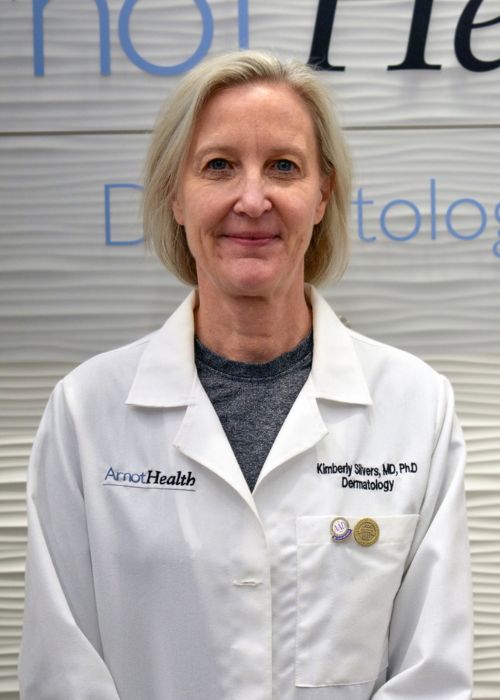
“Skin cancer is the most common cancer in the United States; one-in-five people are diagnosed,” says Dr. Kimberly Silvers, Director of Dermatology at Arnot Health, a Member of Centralus Health.
Photo of Dr. Kimberly Silvers, courtesy of Centralus Health.
Cell carcinomas are the three most common types of skin cancer. Melanoma suddenly appears as a mole or a new dark spot on the skin. Basal cell carcinoma is a flesh-colored, pearl-like bump or a pinkish patch of skin. Squamous cell carcinoma appears as a red firm bump, scaly patch, or a sore that heals and then re-opens. These can usually be cured if detected early, but treatment often leads to small scars.
“It affects all age groups. Melanoma is rare in young people, but we do see teenagers, young women, and young men.”
Dermatologists say it’s important to know the A-B-C-D-E’s of skin cancer. Asymmetrical: moles or spots with irregular shapes in two parts that look very different. Border: moles or spots with outlines that are irregular or jagged. Color: uneven distribution of pigmentation. Diameter: blemishes that are larger than the size of a pea. Evolving: noticeable changes in the skin over weeks or months.

“We can tell pretty quickly, if we see something that’s concerning, whether or not it will need a biopsy.”
When microscopic examination is required to diagnose skin disease, a small sample is sent to the medical laboratory for examination.
“Dermatologists remove the visible portion of the lesion and a small amount of surrounding tissue to be processed in a very particular orientation overnight, to ensure there aren’t any cancerous cells in the specimen,” says Dr. Elizabeth Plocharczyk, Associate Director of Laboratories at Cayuga Health, a Member of Centralus Health.
People can view their lab results, imaging, and test results immediately on MyChart as soon as they are finalized. Lab results are often available as soon as the specimen is processed. To avoid the worry of waiting for a lab result, Dr. Silvers says there are simple steps you can take to lower your risk of developing skin cancer.
“The highest risk for melanoma is sun exposure. Dermatologists recommend SPF 30 sunscreen or above. You apply 30 minutes before you go outside and should reapply every 2 hours.”
It’s recommended to wear broad-spectrum sunscreen, especially between 10 a.m. and 4 p.m. or whenever the UV Index is above 3.
The Centralus Health dermatology team is trained to treat multiple conditions ranging from various forms of skin cancer to acne, rashes, rosacea, and warts. Arnot Health’s Dermatology office is located at 200 Madison Avenue in Elmira.